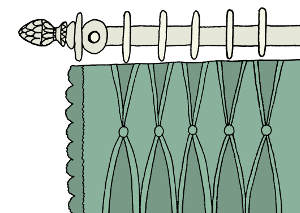

|
Blinds
Blinds can be used alone to dress a window, or in addition to curtains. There are many styles to give a tailored or more sumptuous effect. Many blinds can be fitted inside the window recess which is ideal in rooms such as kitchens where the window is often next to the sink. Contrast borders, hems or trims can be added to add contrast or co-ordinate with other furnishings.
You can also add a pelmet or valance at the top of the blind, or have a pelmet alone to trim a window where a blind or curtain is not required.
-
Roman blinds are very popular.
These are usually flat panels when dropped,
and form even horizontal folds when they are raised via cords
behind the blind.
-
Austrian and festoon blinds are far more gathered and decorative –
more like gathered curtains than flat blinds.
They are gathered across their width and form flounces when raised.
The difference between them is that a festoon blind has gathers
down its length even when fully lowered.
-
London blinds are a cross between a roman and an Austrian blind.
The fullness at the top of the blind is created with pleats
instead of gathers for a more tailored effect.
The blind is raised with cords behind the blind
but gives a softer effect than the straight folds of a roman.
-
Reefed blinds are flat when lowered and roll up from the bottom
via cords that run in front and behind the blind.
They are made double sided which offers the opportunity
to introduce a contrast colour or pattern.
-
Tie-up blinds are perfect for sheer fabrics and for windows
where the blind is not raised and lowered regularly.
They give a relaxed almost scalloped effect
and are held at the desired height by fabric ties
or ribbons made into bows or knots.
If preferred a weight bar can be included and the fabric rolled around it
to the finished position.
This gives a more structured look and requires a decorative lining
as this will be on display as the blind is rolled up.
Line drawings reproduced by kind permission,
© Wendy Fleat of
Alternative Windows
|