
Home
Curtains
Blinds
Soft Furnishings
Fabrics
Alterations
Portfolio
Contact

Curtains

Your choice of curtain heading may be influenced by the function or style of the room. If you are using an existing pole or track this may also influence which heading is suitable. Essentially, the heading is to provide the fullness and drape of the curtains either by stitching a gathering tape to the top of the panel or by making pleats by hand. It also provides the means of hanging the curtains with hooks, eyelets or tabs. Some headings also allow for the addition of a contrasting tab top or button trim.

  • Pencil pleat tape gives even gathers across the width of a curtain and is ideal if you want to cover a plain track or to use behind a pelmet or valance.
  • A tab top gives a contemporary finish and usually hangs from a pole set above the window recess. Tab top curtain It allows quite a lot of light from the window around the top of the curtain so may not be suitable for children’s rooms or nurseries. This style gives a less full curtain, although pleats can be added to counter this. The tabs can be decorated with contrasting buttons. A variation is a tie-on curtain where the curtain panel is hung from the pole with ties or ribbons instead of tabs. Tabs and tie-on curtains are not suitable for heavy fabrics.
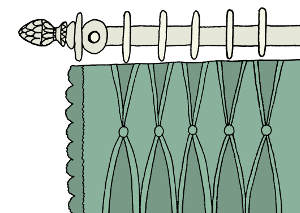
  • Triple or pinch pleat curtain A triple or pinch pleat handmade heading has groups of three tight pleats evenly spaced across the width of the curtain. This can give quite a formal effect.
  • Goblet pleat curtain Handmade goblet pleats are a variation of the triple pleat where one ‘goblet’ with a gathered base is made instead of three pleats in a group.
  • Eyelet topped curtain Eyelet topped curtains have large metal or plastic eyelets set into the top of the curtain panel which then thread on a pole to hang the curtain. They have simple lines and can have deep folds. You can also choose smaller eyelets to hang the panels from a tension wire.
  • Channel or slot headed curtain Channel or slot headed curtains fit directly onto a pole and are used where the curtain is not moved across the pole but held open with a tieback or holdback. This is particularly effective with a sheer fabric where you want to minimise a poor view and do not need lots of light through the window.

Most curtains are lined, but there may be times in a kitchen or bathroom where this is not required. Usually cotton lining is used, but there are purpose-made linings to add thermal or blackout qualities. For a really luxurious effect you might want to consider adding an interlining for extra insulation and thickness. This is particularly useful when making door curtains.

As a finishing touch you may also require a coordinating pelmet, valance, holdbacks or tiebacks which can be made in a variety of styles from the simple to the more elaborate. These are not difficult to fit and can help alter the proportion of a window.

Line drawings reproduced by kind permission,
© Wendy Fleat of Alternative Windows

©2009 Simply Sewing